
What is Absolute Idealism?
On Self-Consciousness and Objectivity

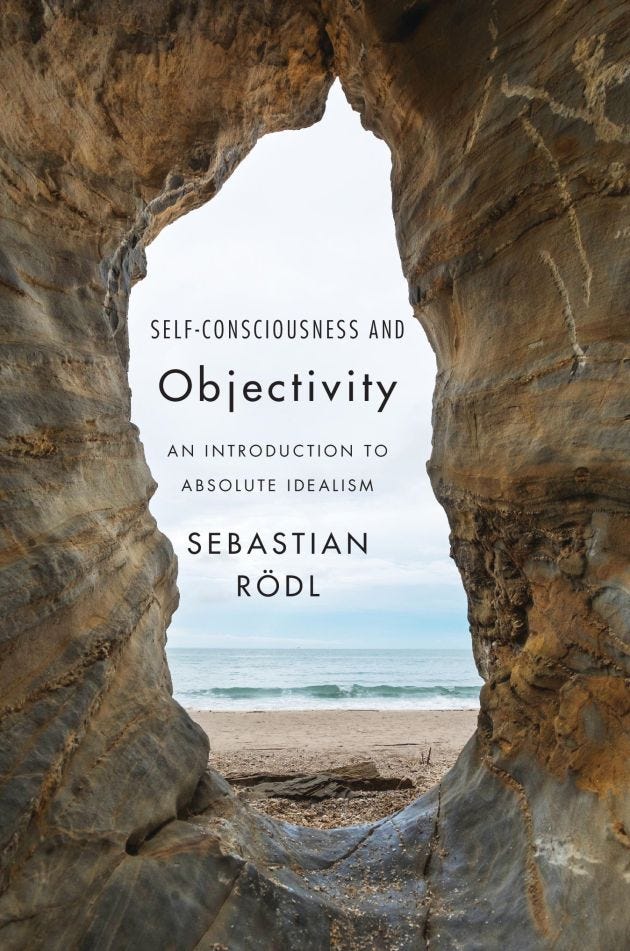
[In all that follows, I am attempting to paraphrase, for the sake of my own comprehension, the thought of Sebastian Rödl. These thoughts are laid down with particular comprehensiveness in his 2018 book.]
What is absolute idealism? Quite simply,
Absolute idealism is the recognition of the identity of self-consciousness and objectivity (subject and object) in the act of judgment. It is the thought that far from being an obstacle to objectivity, the first-person is its necessary form.
This thought should surprise, since it is frequently held that self-consciousness is an obstacle to objectivity. Isn’t self-consciousness, expressed in the first person pronoun, by definition subjective? And so isn’t it the opposite of objective? If we wish to see things as they are, we wish to see them from no point of view; the “I” should disappear in favor of what’s simply the case.
Objectivity, we might think, repels the first person. This is frequently taken to mean either that we cannot reach objectivity (given the first-personal character of our thinking) or that we must expunge the first-person in order to do so.
Absolute idealism takes this common assumption to be profoundly mistaken.
To explain this, we need to elucidate what we mean by self-consciousness and objectivity, with an eye to their relation to judgment.
Self-Consciousness
Self-consciousness is a logical form exhibited wherever the consciousness in question is internal to its object—to that which it is consciousness of.
For example, it is constitutive of marriage that those who get married understand themselves to be doing so. Without this reflexive self-awareness/intention, there can be no marriage—even if we arrange things so that all words and actions we associate with a wedding ceremony are present, we can imagine a case in which the parties do not understand themselves to be getting married and therefore are not married.
In realities exhibiting this form, it is impossible to give a description of the object which abstracts from consciousness of that object. One cannot describe marriage as a given reality in the world which could be as it is anyway, apart from anyone’s consciousness of it, since consciousness of getting married is constitutive of marriage. Another way of saying this: self-consciousness is a form which cannot be viewed from sideways on.
Furthermore, one cannot describe this internality or reflexivity of self-consciousness as if it were a question of two separate acts, or a sort of second-order awareness. As if there were such an object as getting married (in principle identifiable on its own) and we merely stipulated that it is always accompanied by a second act which is consciousness of this first act (that, is getting married). No; such a distinction is not possible. The consciousness is not a second act, or a second order, but is nothing other than that of which it is the consciousness. The consciousness in question and that of which it is the consciousness are a single reality. In self-consciousness, consciousness returns to itself.
The paradigmatic instance of self-consciousness is judgment. In judging, I know myself to judge. But I do not merely know myself to be judging (as an instance of a general activity) but I know myself to be judging this, what I so judge. Still more, I judge myself to be correct in so judging. but this self-comprehension of my judgment “things are so” is nothing other than this judgment itself. My judgment is its own self-comprehension and the thought of its own validity.
Objectivity
What is objectivity? The explanation for judgment being nothing other than what is so judged, and on no given character of she who judges (by given character, we mean something which is not known in this very judgment). Such a judgment is necessary and universal.
But this notion of objectivity is precisely what we found to be the structure of judgment as self-conscious (in its repelling any view from sideways on, and its being the thought of its own validity). Objectivity is what first-person judgment holds itself to be (when it meets its own standard). It is what it says of itself. The form of objectivity is necessarily first-personal.
Conclusion
Let us conclude this too-brief summary with a quotation from Rödl himself:
There is a major obstacle to the reception of absolute idealism, the history of it and, more importantly, the thought of it: this is the notion that absolute idealism is a species of—idealism. In an appropriately vague and vulgar way, idealism can be represented as the idea that the world, nature, the object of experience, depends on the mind. Reality is mind- dependent. Absolute idealism is the most radical, the most thorough, and the only sound rejection of that.
This is excellent Tim, I'm so glad you are doing this.
It is worth lingering on this to bring out more the object of judgment:
"But I do not merely know myself to be judging (as an instance of a general activity) but I know myself to be judging this, what I so judge. Still more, I judge myself to be correct in so judging. but this self-comprehension of my judgment “things are so” is nothing other than this judgment itself. My judgment is its own self-comprehension and the thought of its own validity."
*In* judging p I know myself to judge just this, p. But in judging, and only *in* judging I also know that what I judge is the measure of the judgment itself - only what I judge determines whether the judgment is correct. But judging I understand myself to judge correctly. I understand therefore, what Wittgenstein and McDowell call "thought going all the way to the thing." Not an aspect or a perspective is what determines the truth of my judgment, but the thing itself, since we have not reflected merely a part of it because of the limitations of our nature. No, judgment goes all the way to the thing. This is *why* it must be self-consicous!
Further the object of judgment is always that which provides in its being for its being thought, for *that* is judgment: an account of judgment shows why what it is is its being thought - it is the concept of itself. Rödl mentions that the name for such an object can be "world" "what is" "the facts" "what is the case" etc. These are names for that which is the concept of itself. It is not that judgment is locked up inside itself, no: being self-conscious, it is immediately unlimited in scope, it is the opening to all things, for unlike an organ of sense, it has no character that limits what it can think, what is internal to it. (This is what the a priori forms of intuition are for Kant: a given character of the subject that forces a perspective even on thought, making it like a sense organ).
Great book, those opening pages are hard to read though lol