
How Aristotle Completed the System of (Platonic) Idealism
The Speculative Aristotle: Part III
“The direction of Aristotle’s objections to Platonic philosophy is that Platonism retains a residue of empiricism, granting to the external and given a primacy and independence, which a more complete and thorough idealism, such as Aristotle himself developed, does not concede to the natural and particular. Aristotle, I propose, may be thought of as more Platonic than Plato, in that he attributed to the pantheon of eide greater power and sovereignty in the universe than even Plato imagined possible.”
Dennis House1
In the first installment of this series, I set myself the task of demonstrating Aristotle’s status as a thinker who is genuinely speculative. By this I mean a philosopher of profound mystical and theological depth, one who is capable of setting into unifying movement the conceptual oppositions that abstract thinking keeps apart. This required moving beyond a series of widespread— yet inadequate—philosophical portraits of Aristotle.
In this post, as in the previous, I concern myself with the first claim of my revisionary reading. Rather than abandoning the lofty speculation of the Forms for an earth-bound hylomorphism,
Aristotle radicalizes Platonic idealism so that Mind or the Good are comprehensive causes of all that exists. He does this by discovering a first principle which is inclusive of all subsequent division.
In the second installment, I examined the Platonic philosophical project on the level of first principles. We saw that Plato sought, but did not find, an explanation of sensible reality exclusively in terms of Mind, or the Good. We labeled a commitment to this form of explanation, which Plato learned from Anaxagoras, idealism.
In keeping with this commitment, Plato’s criticism of the doctrine of Forms and the technical discussion of the One and the Dyad in the late dialogues represent an attempt to rationally define the status of the finite and include it within the First Principle.
Yet no resolution, we saw, was forthcoming on the level of thought. Plato falls back in the end on myth and image; their ambiguities reflect the shadowy and insubstantial status of the sensible world. He could not, an more than Anaxagoras, fulfill the promise of idealism (complete explanation through Mind and what is best).
This post will show how, through the discovery of substance, Aristotle provides what Plato could not. He completes the system of (Platonic) idealism, and articulates on the level of thought the One’s inclusion of the finite.
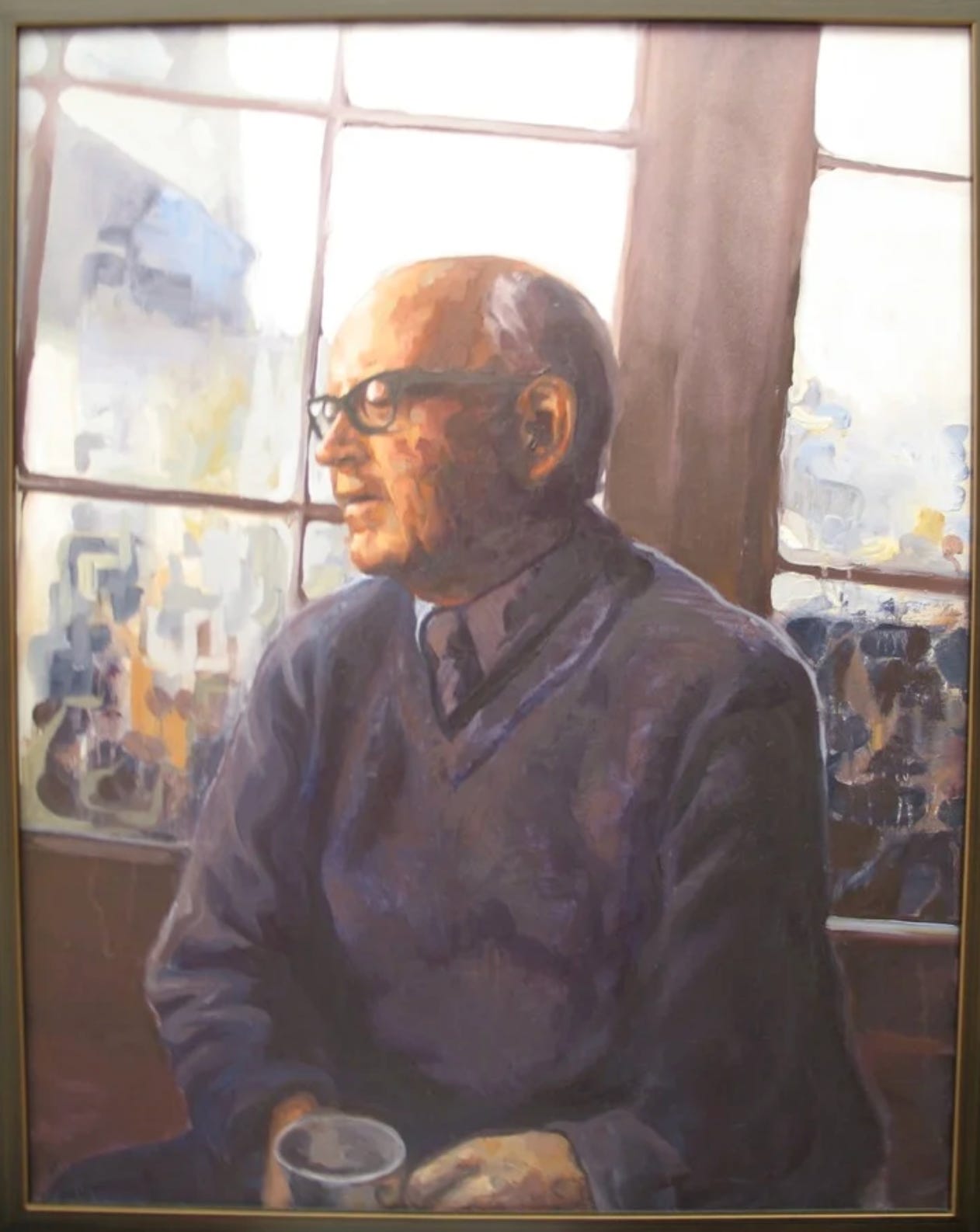
In what follows, I rely on the interpretation of Aristotle pioneered by James Doull and his students in the Dalhousie Classics department.
The Platonic Project in Aristotelian Perspective
Aristotle’s response to Plato must therefore be understood as an immanent working out, on the level of first principles, of the very problems raised by the dialogues in groups (c) and (d) regarding the One and the Good and the One and the Dyad. He does not merely complain that Plato lacks a “science of the sensible” (which would beg the question) but engages with the “scientific” explanation that corresponds to this lack.
Aristotle refines and corrects the Platonic understanding of these principles in the process, but the constellation of problems is inherited. This is both immanent critique—expressible in terms whose force could be felt within the Platonic standpoint—and immanent development.
“Aristotle is at every point revising Plato’s principles not in order to reject the Platonic philosophical project but rather in order to realize it more completely.”
Eli Diamond2
Aristotle’s criticism of Plato is that his account of first principles, as it stands, opens Plato to the very objection he once leveled against Anaxagoras in the Phaedo: he does not fulfill his promise to give an explanation of the way things are in terms of Mind and how it is best for them to be, without reference “to any other sort of cause.” He does not show how Mind can be a comprehensive cause of the finite. To put it in terms of the so-called “unwritten doctrines”: he cannot account for how the One is
productive of otherness and difference
the sole explanation and end of the characteristic activity of each thing
This is to say that he cannot show the One to be the Good. This, of course, was precisely the ambition of his mature work.
“The central problem facing Plato in the later dialogues is to show how the (Platonic) One is productive of what is other than it. … Plato, in the dialogues from the Parmenides on, is trying to comprehend how the (Platonic) One is the (Platonic) Good.”
Lawrence Bruce-Robertson3
Again, the evidence for this claim is not the mere fact that Plato does not produce a “science of the sensible.” The deepest reason why he cannot do so lies in the relation of his two metaphysical principles (indeed, in the fact that they are irreducibly two). Since he endeavors to keep the One free of otherness and division, he must posit a second principle (the Unlimited, or the Indefinite Dyad) whose indeterminacy serves as the substrate of, and occasion, for alterity, difference, and becoming. But this means that Mind (or the Good) cannot be the sole explanatory cause of the finite; the divided principle falls at least partially outside it. Matter represents a residue of sheer givenness which cannot be subjected to the One, and thus the sort of explanation Plato sought in vain from Anaxagoras becomes impossible within his own philosophy as well.
“Anaxagoras posits Nous as both a self-related principle and as effecting the order of the all-mixed world; yet, he is unable to show how Nous, in its isolation, can enter into ordering relationship with the world. While Plato and Aristotle agree on this criticism, Aristotle goes one step further. Aristotle argues that this problem pertains equally to the self-related forms of Platonism.”
Simcha Walfish4
“Would Plato be forced by his own logic to assert that the cause of becoming and plurality does not belong to the operation of Intelligence or the Good but rather to an ancillary cause, not being or a dyadic principle? This conclusion Aristotle accurately understands to be precisely what Plato hoped to avoid.”
Dennis House5
Worse still, the next best option—an explanation of the finite through the combined force these two causal principles—also proves inadequate. As Doull puts it, things cannot be constituted out of “absolute identity and pure indeterminacy because contraries do not combine.”
In short, Plato faces the difficulty that the existence of the concrete cannot be explained by abstractions, whether singly (the One of Parmenides) or through combination or mixture (the One and the Dyad, Limit and the Unlimited). He knows that the finite must be a unity of these moments; the dialectic of the Parmenides shows the self-defeating absurdities which result from positing one in isolation. Another way of putting this is that Plato knows the concrete is the nexus of multiple perspectives—at minimum, that by which it is seen as straining towards form and that by which it approximates the indeterminate. Yet this is a negative rather than a positive dialectic. Plato does not arrive at a single principle capable of comprehending these moments in their unity. The perspective from which the first principle is the One and the perspective from which it is the Good cannot be rationally reconciled. The result is that the unity of the moments falls outside the finite itself to an external observer, or to the ability of myth and image to hold together in tension what cannot yet be thought as one.
“There is need, in the Timaeus for example, of a demiourgos who brings what are naturally opposed principles together to produce the world (to produce nature and the soul)… [The mythical element] is Plato’s philosophical honesty in treating matters which are not yet within his theoretical grasp. The importance of Plato’s images is that they allow us to stand in relation to something which, even if it is intelligible (even if it is the most intelligible of all), we as yet do not understand… They are Plato’s intuitive grasp of what lies beyond the argument and awaits full comprehension.”
Lawrence Bruce-Robertson6
In the absence of a noetic resolution, the choice of whether to emphasize the systematic impulse or aporetic character of the Platonic philosophy (and the phenomenal world as such) falls to the contemporary reader. In this sense, postmodern readings are not without a foothold in the text. The mythical representation of this choice to regard the finite as an orderly cosmos is the role played in the Timaeus by the Demiurge.
In Plato, to be systematic, while it depends on an enlightenment and insight, is also a choice whether one will regard the ambiguous phenomena primarily according to their eidetic order and limit or as indeterminate and disordered. In Timaeus, the Demiurgos himself is represented as making that choice.”
James Doull7
Aristotle’s Idealism: The Discovery of Substance as Activity (ἐνέργεια)
In Aristotle’s principle, we discover what Plato sought but could not find:
a form of explanation in which Mind is the sole cause of what is other than it
a thought (rather than a myth or image) comprehensive of both the divided and undivided moments involved in the finite
We can offer an initial formal description of Aristotle’s reformulated teaching: all difference falls within the first principles self-relation, as the self-difference by which it is what it is. A more familiar name for this Aristotelian thought is the term substance. Aristotle understands substance as fundamentally an activity (ἐνέργεια) which fits exactly this formal description.
As Aristotle explains in the Metaphysics, the basic problem is that all previous thinkers, from the Presocratics to Plato’s mature philosophy, viewed the principles as elements (στοιχεῖα) from which things are composed. They took the search for first principles to entail first identifying the most fundamental constituents of reality, and then explaining the finite through some process of their combination and mixture.
That the putative principles are elements in this sense is obvious in the case of the principles of the Ionic philosophers (earth, water, air, fire etc.) and with Democritus’ atoms. What is less obvious is that this is also the case for the more sophisticated principles championed by Anaxagoras, the Eleatics, and the Pythagoreans (who provide the language later used by Plato himself). Their alleged principles—Mind, Being and Non-Being, the One and the Dyad, Limit and the Unlimited—seem more immaterial than, say, water.
Aristotle realizes, however, that the underlying structure of causal explanation—what we would today call “logical form”—is the same. We are still thinking in terms of (physical) elements and their (external) combination. One has still left unexplained the cause of the combination itself, which remains mysterious (especially if the principles are contraries, which they must be in some sense if one is to explain becoming and change).
Plato realized in the Phaedo that this was true of Anaxagoras, and, in his radical self-criticism in the Parmenides, of his Forms and even the One and the Dyad which succeeded them. He formulated the problem, but it was left to Aristotle to provide the solution.
“Aristotle says that Plato fell prey to numerous difficulties because of the way in which he formed the problem. Namely, Plato makes every principle an element, makes contraries his principles, and the One or Unity a principle [Metaphysics 1092a5-9]. Aristotle allows that this logical structure is an advance beyond Plato’s predecessors but argues that, while Plato was able to formulate the dilemma, he was not able to solve it in terms of his own logic.”
Dennis House8
This solution is the idea that what is most fundamental are not elements (στοιχεῖα) but an activity (ἐνέργεια) of self-maintenance: a thing’s being-at-work-staying-itself. The various distinctions we make in considering a thing—divided and undivided, form and matter, etc.—are abstractions from this. What were taken by previous philosophers as fundamental elements are in truth “sides” or “moments” of this one dynamic and concrete activity. (This is, incidentally, why Aristotle can be so casual in the Physics about how many principles there are of change: “there is a way in which one must say that the starting points are two, and another in which in they are three.”)
“In Metaphysics A Aristotle says, somewhat cryptically,
that Plato’s principles are posterior to what they are supposed to be principles of. That is, rather than accounting for the many Forms, or the sensibles which participate in these, the One and the Dyad are abstractions, and as such are posterior to that from which they are abstracted… Unlike his predecessors, Aristotle begins with what is one: substance. This is not a contrary, but is receptive of contraries.”
Lawrence Bruce-Robertson9
Substance divides itself into form and matter, actuality and potency, etc. These divisions, however, do not jeopardize self-identity, but are sides of a single activity. These and other divisions are the movement by which a thing is what it is; they are sublated in this same movement in its return to itself.
“The form and the matter are two sides of the same activity, and to say that matter is the potentiality of the complete activity of form is to say that it is the extrinsic side of the inner identity.”
Eli Diamond10
This self-identity in self-othering or inclusive self-division is more and more perfect as we encounter things which more fully are—substance is predicated by a pros hen analogy to its paradigmatic instance: Life, or better, Self-Thinking Thought.
This thought of substance is inseparable from the notion of inner purposiveness (τέλος), the way in the good for a thing is the explanation of its unity. Aristotelian teleology is the realization of Plato’s ambition to bring together in this doctrine of principles both the One and the Good.
Matter, potency, and the indeterminate—these are not for Aristotle, unlike Plato, accounted for by a second, divided principle which is merely given. The material and potential component of a thing are intelligible solely in terms of what it needs to be itself, to actualize its form. (One could say: they are produced by and included within the negative moment of a substance’s self-relation).. They do not exist outside of and apart from form. Mind, or what is best, is a cause comprehensive of form and matter.
“Matter in Aristotle’s view can only be taken separately for a thinking which is external to its object; instead, properly, matter is a principle of thought.”
Dennis House11
“Matter is simply the expression and externalization of exactly what will be required for the being to live out the activities specified in its form. In other words, there is nothing ultimate except for the activity of form… A natural thing, ultimately, is form all the way down and so no matter what is being studied, there is rationality and goodness and ideality present—studying bees and grubs and digestion and blood and the heart is not a flight from speculative philosophy but a demonstration that everything is explained by the causal activity of form in matter.”
Eli Diamond12
Aristotle, therefore, realizes the project of (Platonic) idealism, the ambition first expressed by Anaxagoras. It is because of this idealism that he is so interested in nature and the concrete, and it is because of this idealism that he is so successful in the study of them. As Lawrence Bruce-Robertson puts it: “Plato’s image of participation becomes Aristotle’s concept of substantial unity… it is not that Aristotle has drawn the Forms down into the sensible, but that he has drawn the sensible up into the intelligible.”
“Aristotle’s empiricism and his endless interest in every last detail about the natural world and the animal bodies in it does not involve a turn away from Platonic idealism, but rather an intensification of this idealism, one which seeks to realize the deepest ambitions of Plato’s thinking.”
Eli Diamond13
Dennis House, “Did Aristotle Understand Plato?” Dionysius 17 (1999): 7-25; 12. https://ojs.library.dal.ca/dionysius/article/view/6238
Eli Diamond, “Embodied Essence, Two-Footedness, and the Animal with Logos.” In Aristotle on Human Nature : The Animal with Logos, 21-38; 22. Edited by Gregory Kirk and Joseph Arel. London: Bloomsbury, 2023. Draft available online: https://www.academia.edu/14854378/Embodied_Essence_Two_Footedness_and_the_Animal_with_Logos.
Bruce-Robertson, Lawrence. “An Introduction to James Doull’s Interpretation of Aristotle.” Animus: the Canadian Journal of Philosophy and the Humanities 10 (2005): 17-29; 20.
Simcha Walfish, “An Instructive Failure: The Status of Anaxagoras in Plato’s Phaedo and Parmenides, and Aristotle’s Metaphysics Book A.” Pseudo-Dionysius 15 (2013): 1-9; 1.
House, 20.
Bruce-Robertson, 23.
James Doull, “Findlay and Plato,” in Studies in the Philosophy of J.N. Findlay, eds. Robert S. Cohen, Richard M. Martin and Merold Westphal, 250-262; 254.
House, 20.
Bruce-Robertson, 24-25.
Diamond, 24.
House, 23.
Diamond, 24.
Diamond, 22.
I am a little too rusty on this to be sure how much I agree off the bat, but initially I'm impressed! I'll keep checking each out and I expect it will be worth going back to the series when I next refresh my memory of Plato and Aristotle again.
Another excellent and insightful post!
One thing that stood out was the use of "activity" to translate ἐνέργεια. I think it is more common to translate this as "actuality" or "act". If ἐνέργεια just means "activity" in Greek, than I can see the reason for sticking with it. But does it? Aristotle is so often careful about not crossing Categories, or noting when something does, that it seems he would be the last person to call a substance (or even its principles, matter or form) an activity.
To be clear, I have not read the Metaphysics or Physics in Greek, and I do not have an specialty there. It just seemed like an unnatural and uncommon rendering to me, though I see that it is used that way in the quotations you gave from other authors.